I stumbled across geocoins.io almost by chance and… spent a lot of time there. Far too much time, actually. A geocaching question, a virtual geocoin to win, a growing collection… and always a good reason to say, “Go on, just one more!”
After playing for a while, I wanted to go behind the scenes. Who comes up with all these questions? How do you choose which caches become geocoins? And how do you build a game single-handedly that keeps geocachers at their screens instead of sending them out to find boxes?
So I put my questions to qgx, its creator. From his first ideas to his future plans, via technical headaches and players’ suggestions, he tells us the story of Geocoins.io.
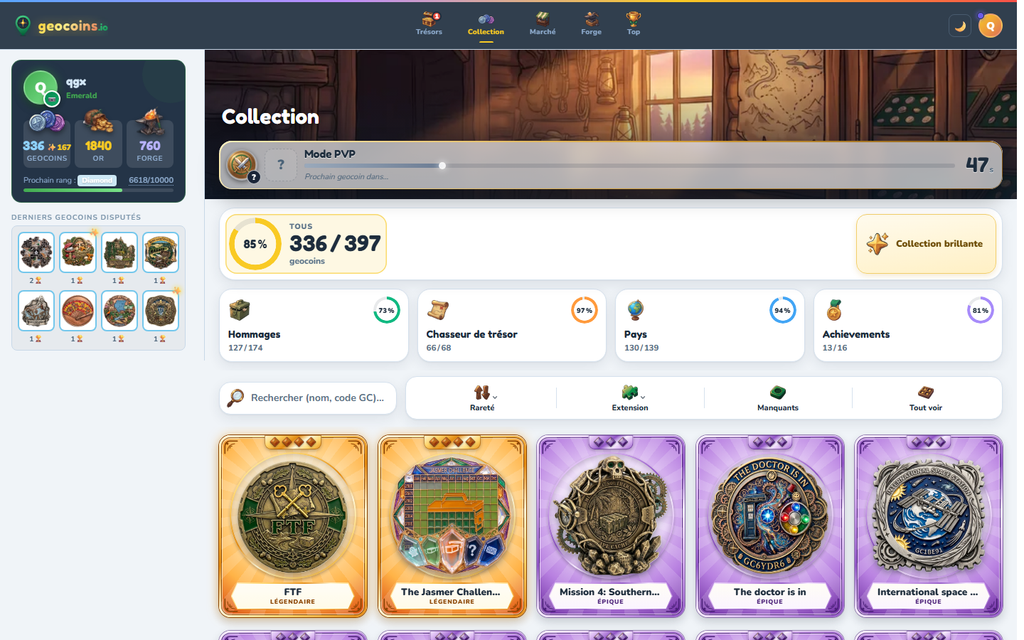
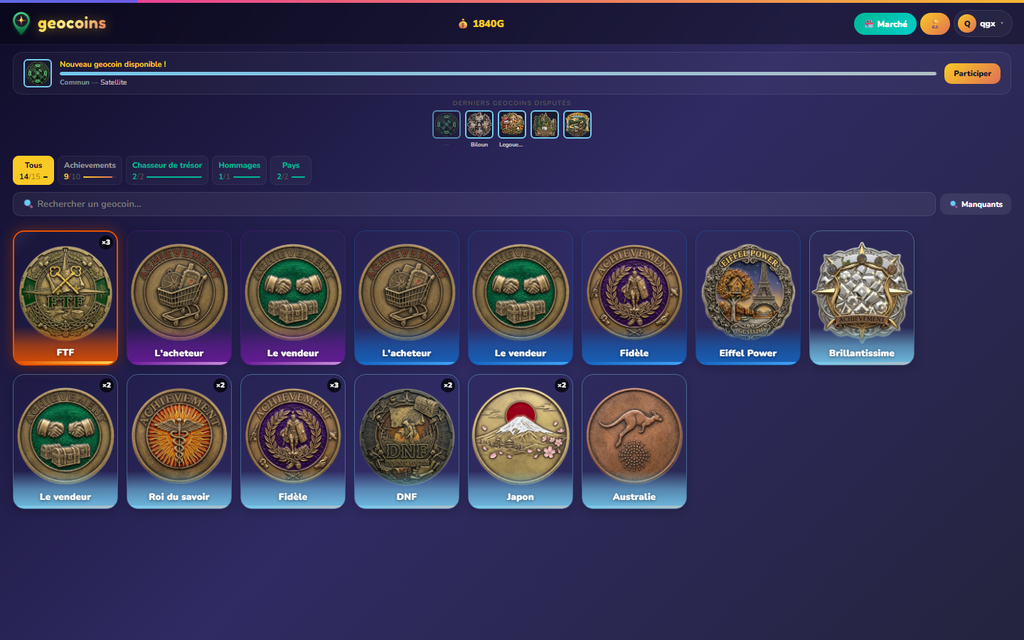
The screenshots in this article show the French version of the game. The interface and quiz questions are also available in English.
Meet Qgx
First of all, could you introduce yourself as a geocacher? Do you have a particular connection with geocoins?
On geocaching.com, I’m qgx, and I’ve been registered since 12 March 2012. My very first day of geocaching was while on holiday in Asturias, Spain. I didn’t know it yet, but I had just been drawn into something that would never let me go. Fourteen years later, the counter stands at 16,705 finds and 535 caches hidden.
I soon caught the bug for the game’s history. I love caches with a past, especially types you can no longer create today. If I had to pick just one, it would be my expedition to Brazil on 31 March 2016, heading for a Project A.P.E. cache in the middle of the Amazon rainforest. Opening that box felt like touching a relic. Since then, geocaching has taken me to around thirty countries.
But my real weakness is mystery caches. Solving them, and creating them even more. In 2018, I hid a series called GeoAventure (GC7K4M1). It’s a little 2D video game in which you play a muggle discovering geocaching, talk to the inhabitants of a village, and only receive the coordinates at the end of the adventure. In 2022, Geocaching HQ named the second episode Geocache of the Week, which I’m very proud of.
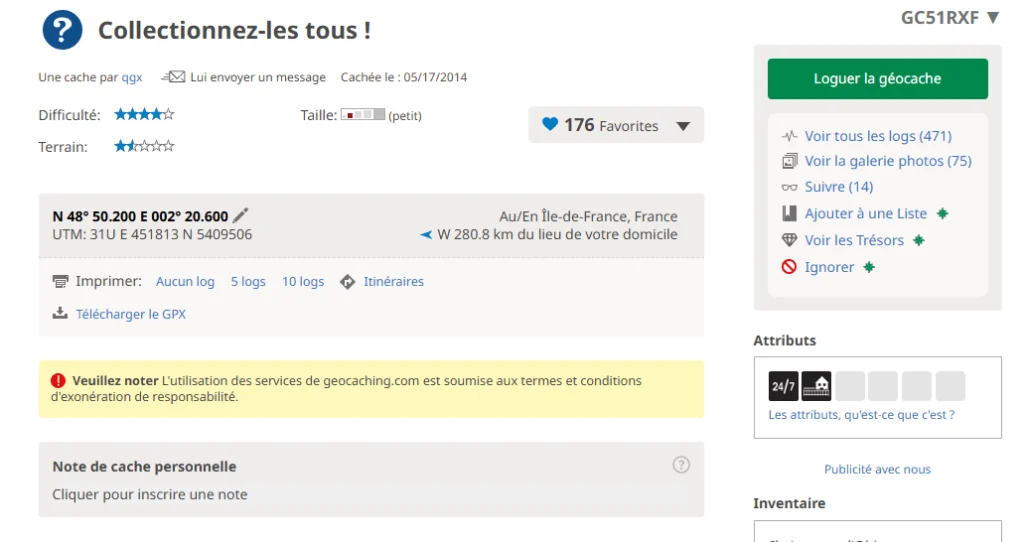
And where do geocoins fit into all this? In 2014, I hid the cache Collectionnez-les tous! (“Collect Them All!”, GC51RXF). The idea is that around a hundred virtual geocoins appear as you revisit the cache page, in five rarities, including a legendary one that only appears once in a thousand visits. You have to keep coming back to complete your collection. The idea even travelled to China, where a cache uses the same concept and thanks me in its listing. I like to say it’s the direct ancestor of geocoins.io, twelve years ahead of its time.
You built geocoins.io from scratch. Is software development your profession? Do you work on the project alone, or are other people involved?
I’m a software engineer, and development is both a passion and a hobby. Technology moves so quickly that I always have one or two personal projects on the go to keep up. geocoins.io has become by far the biggest of them: it’s the perfect playground for building a complete system from scratch—a real-time server, a database, a website, a Discord bot, notifications, a shop and so on—while talking about something I love.
Alone? When it comes to coding, yes. I’m the only developer, the only person making the geocoins, the only one writing the questions, and the only one getting the alert when the server starts coughing at three in the morning. Development tools now include AI, which saves valuable time when you know your way around software. But I’ve never felt alone, because the game has a team that doesn’t appear on any organisational chart: its players. They proofread the questions, hunt down bugs, test on their computers and smartphones, and suggest ideas every day. I don’t have an iPhone: for months, I fixed things “blind” using screenshots from Tristaaaaan, who would send them with a little message: “Hi Q, a lovely iPhone screenshot, just how you like them 😂”.
The birth of geocoins.io
How would you describe geocoins.io to a geocacher who hasn’t heard of it?
It’s a live geocaching trivia quiz. A question appears, all connected players receive it at the same time, and the first person to type the correct answer wins a virtual geocoin. Then another. Then another, and another… And you can’t stop.
Around that quiz is everything a collector loves: four rarities—common, rare, epic and legendary—shiny versions, a market for trading duplicates, a forge for melting them down and creating others, quests, seasons, achievements and rankings. Above all, every geocoin tells a story. Almost half of them pay tribute to real geocaches, from The Original Stash (GCF), the very first, to a cache hidden in Antarctica. You play, you learn, and your list of caches to visit grows before your eyes. Denfire puts it better than I can: his cache bucket list “has grown quite a bit since a certain game came along 😉”.
It’s free, ad-free, available in four languages, and works just as well on a computer as on a phone. Even when you’re out walking, “there’s always time to grab a geocoin between two caches”, according to Kos, currently top of the game’s rankings.
How did the idea for geocoins.io come about? What was your original goal, what are your ambitions for the site today, and what were the key milestones?
Great question, because geocoins.io very nearly never existed. In May 2026, it was a tiny project for a mystery cache: you had to collect 100 geocoins in the game, and the cache coordinates were hidden in the description of one of the achievements. The reviewer didn’t approve the cache. Game over, curtain down. I came very close to closing the site. The pioneers still remember: in June, on Discord, Aklem said, “Don’t tell him we’ve got the coordinates for the mystery cache that hasn’t been hidden.” I’d forgotten to remove the message containing the coordinates from the game. I replied, a little wistfully, “The mystery cache that will never be 🥲”.
Before pulling the plug, I talked to Arnokovic, with whom I occasionally exchange ideas. Then I saw him logging in day and night. He couldn’t tear himself away. I thought I might be onto a nice idea. I kept going, and word of mouth did the rest.
The key milestones, in fast-forward:
– 3 May 2026: the very first line of code. A nice coincidence: The Original Stash, the first geocache in history, was hidden on 3 May 2000, exactly 26 years earlier to the day.
– 27 May: I published the first release notes, “Welcome to geocoins!” That’s when I started telling a few contacts more widely about the game.
– 27 May to 11 June: the pioneers arrived. Arnokovic got things started on 27 May, followed, between 8 and 11 June, by HeartlessInc, Aklem, Tristaaaaan, tbgv31, Prolifix, Nounourspirit, Mathémax, Nebola, Rrhyko and viatru, in that order. On 12 June, they inaugurated the Discord server.
– July: the big wave, with more than 200 new players in a month.
– August: geocoins.fr became geocoins.io to welcome the Belgian, Canadian, Portuguese and Brazilian players who were arriving. Then, on the 28th, came the Reviewer expansion, taking the collection from 204 to 400 geocoins, and the opening of the crowdfunding shop.
– October: the game’s first big event, “Poupy d’Halloween”, in which you feed a little cat who loves devouring geocoins.
My ambition today? For geocoins.io to become a little daily meeting place for the geocaching community. Somewhere to learn the game’s history while having fun, and to cross paths before meeting at an event. It’s already happening: at the Mos’hell MEGA in early November, Aklem summed up the weekend like this: “That MEGA was practically a Geocoins.io convention 😅”.
What were your main inspirations for the way geocoins.io works and its visual world? Did you set out to create such an addictive collecting and progression game, or did those mechanics develop gradually?
Twelve years passed between the idea and making it happen: Collectionnez-les tous! dates from 2014, geocoins.io from 2026. What was missing in between was mainly time, and the skills to build a reliable real-time game. The idea had plenty of time to mature in the back of my mind. There were even three complete redesigns before the version players know today.
For the game’s world, I drew inspiration from geocaching itself: its memories, cache types, challenges and history. And I often compare the achievement tiers to Project-GC’s diamond badges.
After that, player feedback shaped the rest, one problem at a time:
– Too many duplicates and not enough buyers at the market? On 14 June, Nebola suggested recycling them. That very evening, players could melt their geocoins down to forge new ones.
– Too difficult for beginners? Nounourspirit, with a slow connection, stood no chance against the fastest players. That same day, a mode where speed doesn’t matter was born: Training mode. Beginner PvP followed—a stepping stone before being thrown to the wolves—along with information sheets to help find the answers.
– A collection completed in a few days? Add geocoins and introduce a daily limit.
– Frustrated when a rare one comes up after you’ve reached your limit? Invent storage, so you can set the geocoin aside and collect it later.
– And once you’ve reached all your limits? Keep playing “for glory”: show that you answered first, but let another player receive the geocoin. The idea grew out of a “hibernation mode” suggested by Arnokovic.
Little by little, one piece of feedback after another, we arrived at today’s game. As for the addictive side… let’s just say collecting does the work all by itself.
Geocoins, questions and stories
Could you share a few figures to give us an idea of the game’s scale? How many geocoins, featured caches and questions does it currently contain?
Here’s a snapshot as of 3 November 2026.
Let’s start with the geocoins:
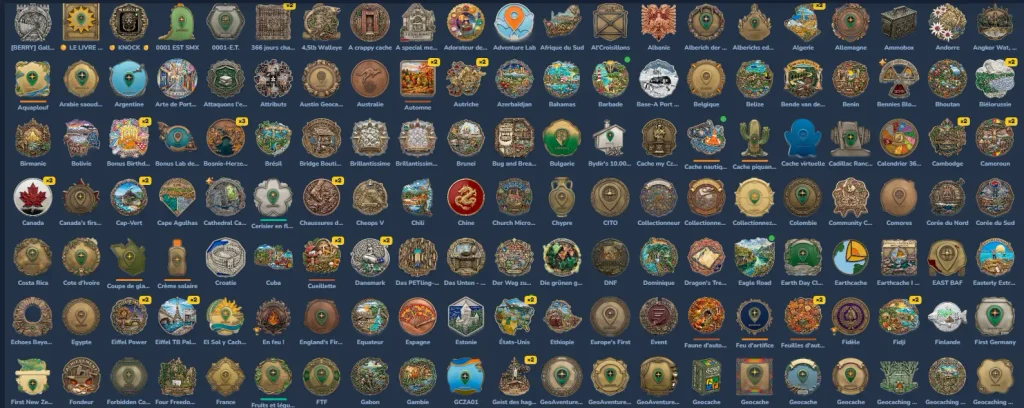
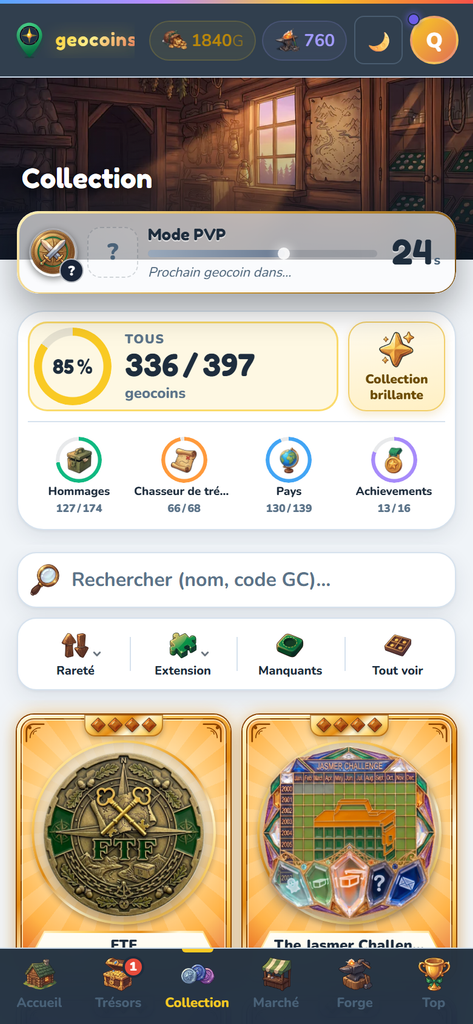
– 403 geocoins in the game: 381 collectable geocoins—236 common, 103 rare, 36 epic and 6 legendary—and 22 evolving achievements that rise from common to legendary as you progress. There are 213 in the base game and 190 in the Reviewer expansion.
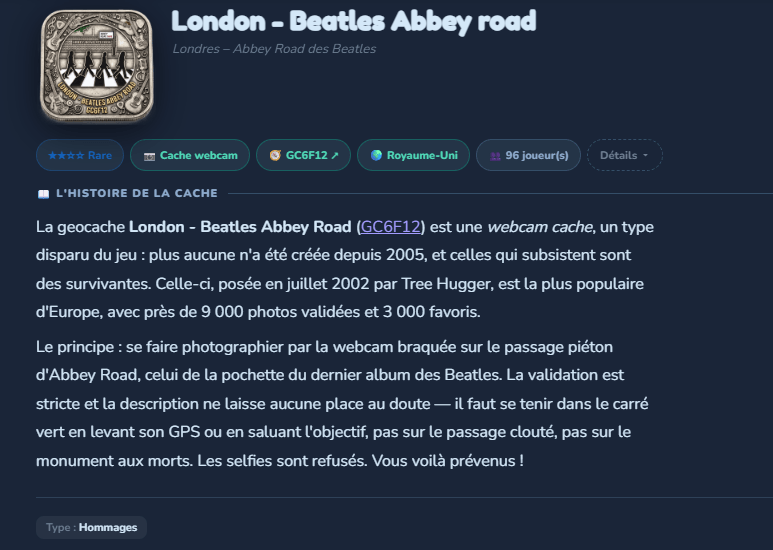
– 174 tributes to real geocaches, active or archived, in 46 countries: from Namibia to Nepal, Kazakhstan to Antarctica, and even North Korea. The oldest, The Original Stash (GCF), was hidden in Oregon on 3 May 2000.
– Almost every cache type: 99 traditionals, 14 multis, 13 mysteries, 13 Project A.P.E. caches, 10 virtuals, 7 EarthCaches, 7 letterboxes, and rarities such as webcams, Wherigos, locationless caches, two MEGAs, an event, a CITO and two Geocaching HQ caches.
– Alongside those: 139 “Country” geocoins and 68 “Treasure Hunter” geocoins—the FTF, the DNF, the ammo box, the headlamp, The Jasmer Challenge and more—including 24 seasonal geocoins.
As for the game in action:
– More than 430,000 rounds played and more than 570,000 answers submitted.
– Nearly 85,000 geocoins added to collections, 39,000 market sales and 3,600 geocoins gifted through the patronage feature.
– On the French-speaking Discord, the bot has announced 192 legendary geocoins since late August. The most frequently awarded? Prague bridges 1 – Karluv most, won 49 times.
The game features many caches that are still active or have since been archived. How do you choose which ones become geocoins? Do you look for famous, historic or unusual caches, or mainly try to represent different countries fairly?
For the first hundred, I drew on my personal favourites, the caches that had made the biggest impression on me. Then came historic caches, Geocaches of the Week, caches featured in geocaching books, and player suggestions. By August, Discord had become an ideas box: agnes.fleur suggested GC72, Finland’s oldest cache; Nebola suggested the cache at the summit of Kilimanjaro and the oldest cache in Africa. Some players’ own caches have even become tribute geocoins.
My guiding principle is to take people on a journey. To make a player think, “Wow, that kind of cache really exists!” And to help them discover, or rediscover, the history of a game that is now more than a quarter of a century old. The countries follow naturally: when you look for extraordinary caches, you inevitably end up travelling around the world.
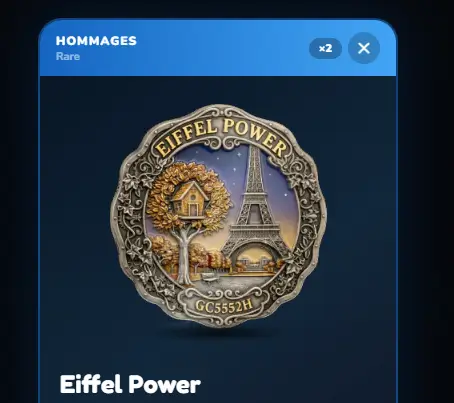
What I like best is when the virtual game leads people outdoors. Aklem made a GPX file of all the tribute caches so he could find them in real life. Exlone shared his outing in Paris with a player he’d referred to geocoins.io, to find Eiffel Power.
The game seems to contain several hundred questions. How do you find, select and check them?
Several hundred? 1,284, to be precise! That represents hours and hours of work.
There are two families:
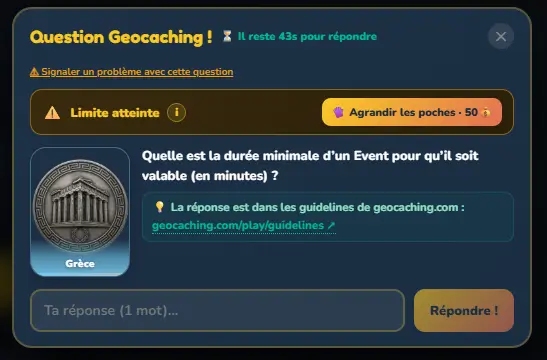
– 672 questions come from the tribute geocoins. For each cache, four questions recur: its rarity in the game, its cache type, its country and its GC code. That’s easy to automate and doesn’t take me much time.
– 612 questions are written entirely by hand: geocaching history, terminology, rules, records and anecdotes.
To check them, I go back to the sources, sometimes a long way back. For the Project A.P.E. caches, I even tracked down archives from the time, including Dave Ulmer filming himself getting an FTF. Arnokovic immediately warned me: “I hope you haven’t got a question like ‘What year did Dave Ulmer die?’ because he’s not dead, whatever some websites say 😂”.
And my best weapon is still collective proofreading. Arnokovic went through the early questions so thoroughly that I sometimes wondered how he even found my wrong answers. Players spot an O mistaken for a zero in a GC code, a misspelt country or an answer that’s too restrictive. One day, an actual geocaching.com reviewer dropped by and corrected a few questions. I admit I was rather proud.
How do you maintain and expand so much content? Do you regularly add new caches, geocoins and questions, or mainly release major updates?
A bit of both. There are regular day-to-day additions: questions, corrections and seasonal geocoins. Then, every three to six months, an expansion adds 100 to 200 geocoins at once.
In between, events keep the calendar lively. Shiny Day, when shiny geocoins rain down all day—“it’s so shiny it hurts your eyes”, as Kos put it. Seasons, with geocoins that come and go. And this autumn, Poupy d’Halloween: a greedy cat everyone had to feed duplicates to unlock tiers of rewards together. Poupy is real—he’s my cat—and he put on quite a bit of weight in October. I promise: a strict diet after Halloween.
And there’s more on the way: Christmas preparations are underway, with a few surprises in Santa’s sack. Then, on 2 January 2027, the next expansion joins the game: Lackey. I hadn’t told anyone before this interview, so there’s an exclusive for you! I’m saying no more… for now 😉

Behind the scenes of development
You can tell an enormous amount of work has gone into the site. Can you estimate how long it took to reach this point? Did some parts take much more work than expected?
Yes, and the figures are a little dizzying. I added them up in release notes published on geocoins.io on 28 August, and updated them as of 3 November:
– 2,257 commits since the very first line of code. A commit is the smallest unit of a developer’s work: a saved change, dated and explained in a sentence. At the end of August, there had been 1,685.
– Around 267,000 lines of code, up from 153,000 at the end of August: the game has almost doubled in size in two months. Of those, some 67,000 lines exist solely to test the rest. These automated checks run through the game’s rules after every change, so a fix doesn’t silently break another part of the game.
– 153 working days out of 185 calendar days, including evenings, nights and weekends.
– A little over 800 hours of development, excluding the time spent creating the geocoins themselves.
Beyond the code, creating a geocoin takes between ten minutes and two hours: finding the cache, researching its history, creating the artwork, writing the description and questions, then translating everything.
What took far more work than expected? Getting the game to work properly on phones, without a doubt. The “Join” button spilling off the edge of the screen, for example, or the countdown I battled with for almost two months before it worked correctly. Then there’s balancing, which I’ll come back to. And the content: every tribute geocoin is a little historical investigation.
What has been the hardest technical challenge to solve since the project began?
Real time. On paper, it’s simple: one question, and the first correct answer wins. In real life, it’s twenty-five people hitting the buzzer in the same second: one on fibre broadband, another on 4G deep in the woods, a third on a train. The server has to decide within a tenth of a second, without ever getting it wrong, and everyone must see the same result at the same time. I sometimes go through a round tenth by tenth to explain to a player why they missed out on a geocoin.
There were also traffic spikes that slowed the server to a crawl. Several things had to be rebuilt more than once, and it was partly thanks to the players, through the shop, that we could double the server’s capacity.
The second final boss is the iPhone… which I don’t own. Apple tends to do things differently. One evening in July, Fleura64 started receiving questions in German because iOS, the iPhone’s operating system, had introduced a bug in Safari, Apple’s web browser. We had a good laugh. Olivier57 tried to offer some comfort: “Well, in a few months you’ll be used to the German questions.” I replied “Sehr seltsam”—“very strange”—before fixing it straight away. It also took a serious game of Tetris to fit the interface onto a small screen, especially as it behaves differently on an iPhone.
One of the game’s great achievements is its balance between the many options and settings, allowing very different players to progress together. How do you work on that balance? Are there any mechanics you’re still not entirely happy with?
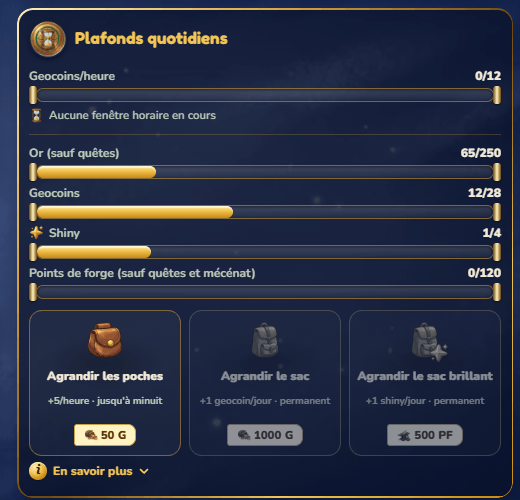
Thank you, because that’s by far the hardest part. Balancing a game is a much more demanding job than I’d imagined. Every setting has its supporters and opponents, sometimes on the same day. My favourite memory is introducing a weekly cap for each rarity: I’d set a maximum of 80 rares per week. One morning in September, I conceded that it might indeed be a little high. Two hours later, other arguments came in, and I wrote that perhaps it was a little low after all. Both were true, for different players!
My method is simple: listen, allow a few days to gather statistics, sleep on it if necessary, then make a decision and release the change.
What still bothers me? The game remains too difficult for beginners. Against the fastest players, a newcomer barely has time to read the question. Some players even have a tactic: look at who won the last eight geocoins, and if the fastest people are around, switch to Training while they wait. We’ve already done a lot: Training mode, beginner PvP, hints that open the relevant geocoin’s information sheet directly, several geocoins per round when it’s busy, and “For Glory” mode, which leaves the win to someone else once you’ve reached your limits.
Discord feedback is invaluable because it’s honest. When you arrived in late October—AngeEtDemon—and described your first visit as “What are all these things?”, I realised the game had become too complex for newcomers and that concepts needed introducing gradually. I thought about it overnight, and two days later the whole new-player introduction had been rebuilt: the game now reveals itself step by step, with a guide, instead of showing everything at once.
The next possibility? Perhaps a more private mode where you only face your friends. What I don’t want is to split the community into leagues: I like the fact that “we all play together”, and introducing tiers would break that.
Are there any features you find especially useful or interesting that players still overlook or misunderstand?
Patronage, without a doubt. Here’s how it works: once you’ve reached your weekly cap for a rarity—rare, epic or legendary—you can still win a round and give the geocoin away. Choose who gets it, or leave it to chance: another player receives it, and you earn forge points in the process. The idea took root back in June, when Myri@m asked why you couldn’t give a geocoin to another player. It’s become one of the mechanics I’m proudest of: more than 3,600 geocoins gifted so far, including around thirty legendaries, most of them FTFs. Each time, the Discord bot celebrates “a legendary patron”. And after making a gift, Nounourspirit said something that sums up what this feature is about: “I hope the person who received it keeps playing.”
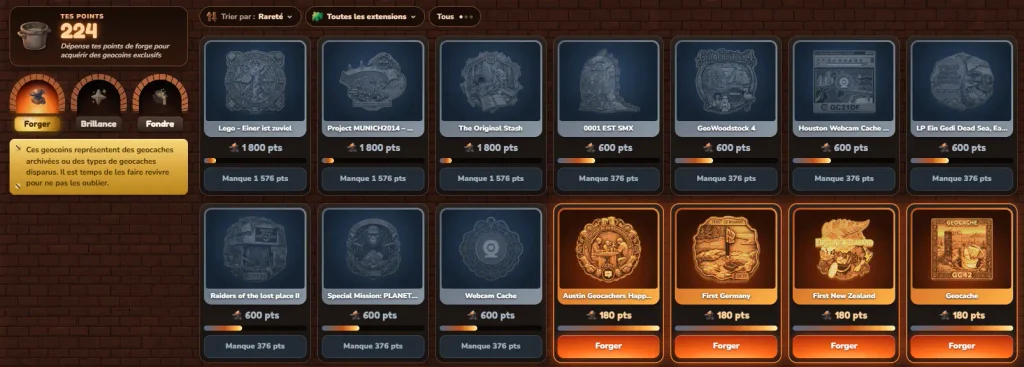
The second underrated gem is forge points, known as PF in the French interface. Many beginners barely give them a glance, even though they’re clearly the game’s most valuable currency. You earn them by melting down duplicates, playing for glory, and taking part in quests and events. And they’re useful for almost everything: forging a geocoin you’re missing, making it shiny, expanding your slots and even buying profile decorations. Earning PF takes time, but it’s very rewarding in the end.
The players and the community
How has the community received the site? Do you have a picture of who the players are, which countries they come from and how they play?
Wonderfully well. Today, geocoins.io has 426 registered players, including 132 who have played this month. The record is 32 players connected at once. The vast majority are French-speaking, from France, Belgium and Canada, with players in Portugal, Brazil and the United Kingdom too. That’s why geocoins.fr became geocoins.io. From the UK, wildeagle wrote in the international channel: “love the Geocoins game and have recommended to my friends”.
It all began with Arnokovic, the very first player. I saw him online day and night, and that’s when I realised how addictive the game could be. He spent an incredible amount of time proofreading every question and reporting the earliest bugs. Aklem, Nebola, Tristaaaaan and Nounourspirit soon arrived. Back then, there were no limits: you could farm day and night, and they certainly did. Nebola readily admitted it: “It’s more than regular play; it’s an obsession!” At 3:16 in the morning, a newcomer, Letintin45, asked in disbelief: “What are you all doing on the game at this hour lol?”
Together, we quickly came to three conclusions. Daily limits were essential to avoid burning out on the game. More geocoins needed to be awarded per round when it was busy. And 100 geocoins were far too few: we went to 200, then 400 with the Reviewer expansion. We also had to rein in the fastest players’ endless winning streaks with what I called an anti-domination handicap, officially named “player on fire”.
The best part is that it all happened through word of mouth. On Reddit, the first posts were met with suspicion: many people thought it was a scam, “too good to be true”, and my account got banned. That was a very lonely moment! Then July arrived, bringing more than 200 new players in a month: Kos, TheLittleSong, Denfire, VAMS67, Kurppe and so many others.
One little private source of pride: in the very first month, Geocaching HQ lackeys created accounts. Probably “just to see”… and they didn’t stay. I’d love them to come back and take a look today, to see how far it’s come! And perhaps it’s no coincidence that the next expansion is called Lackey.
As for how people play, everyone has their own way:
– On their lunch break, like Kurppe: “Best lunch break: two achievements turned legendary and a shiny legendary in storage 😄”.
– At the office, like [a player whose name I’ll keep quiet so they don’t get into trouble], who won a legendary “while waiting for my boss, who was running late 😂”.
– In large doses: one day, Kurppe counted 937 answers in a day, representing eight hours of questions.
– As a family: Mathémax’s son doesn’t like geocaching, but is becoming a Geocoins expert.
– While mowing the lawn. On 6 October, Kos posted a photo of his phone mounted on his lawnmower, with a poll: “1. Everything is fine in the best of all possible worlds / 2. Addicted, but it’s manageable / 3. Have me committed.” I voted 3. Ysa84, eyes fixed on the geocoin mower, missed a shiny Jasmer at that very moment, which finally allowed TheLittleSong to win it. A fine distraction tactic.
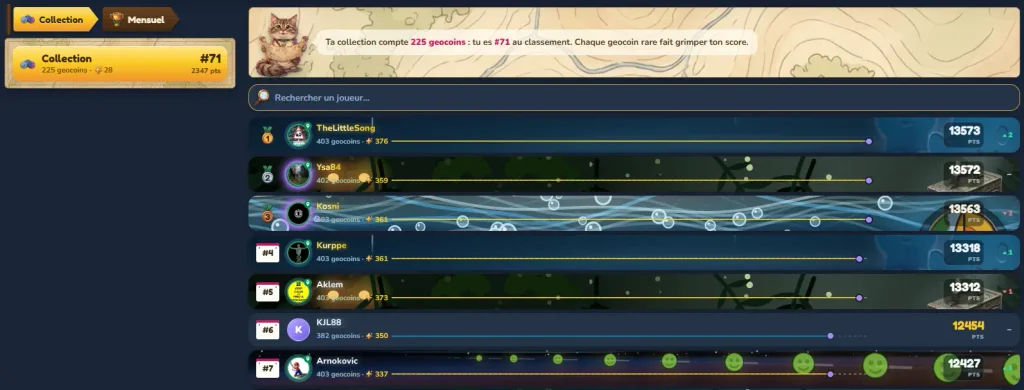
Do you play geocoins.io yourself? As its designer, do you follow how players progress and use the various features? Have they invented strategies or used certain mechanics in ways you hadn’t anticipated?
Of course! You have to taste your own cooking to know whether it’s any good. I play often, and I’m currently 28th in the rankings. The players don’t go easy on me, and the feeling is mutual.
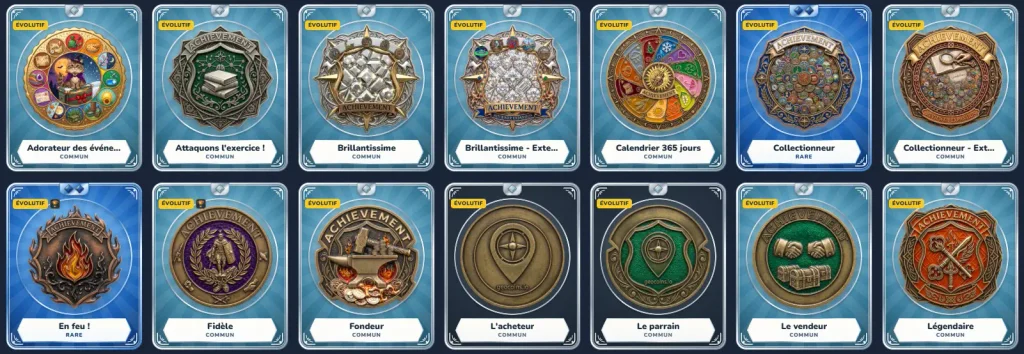
Naturally, I keep a close eye on how players progress, and they surprise me every day. There’s a lot of mutual help, particularly to unlock buying and selling achievements: players agree to exchange geocoins on the market. Buying advances “The Buyer” achievement; selling advances “The Seller”.
Then there are the tricks for squeezing out as many PF as possible:
– Buying to melt down: some people buy geocoins at the market solely to melt them in the forge. In effect, they turn their gold into forge points—a trick some players use a lot, according to the stats.
– Choosing what to keep. Players often prefer to put a legendary in storage rather than a shiny, because melting down a legendary pays handsomely.
– Being clever about the question. Some skim the question starting at the end, then answer using abbreviations or in English. Answers are accepted in all four languages, and English is often quicker to type!
– Choosing when to play. Others target quieter hours, afternoons when the fastest players are playing for glory, and rounds with three geocoins.
What didn’t I see coming at all? On the evening the Reviewer expansion launched, I was surprised to see so many people in Training mode. VAMS67’s explanation: “To pick up the answers to the new questions 😂😂”. Can’t argue with that.
Has any player feedback particularly stayed with you? Have community suggestions or behaviour ever led you to radically change a feature or create a new one?
Yes, all the time. Much of the game was born in the suggestions channel. A few examples:
– The loyalty card. In September, we were discussing the “Loyal” achievement, which requires you to play every day. Arnokovic objected: “Being loyal doesn’t mean being there every day. I’ve got a Monop loyalty card and I don’t go there every day 😛”. Within an hour, I’d come up with a new achievement: the “365-Day Calendar”, complete with a secret square that appears for the 366th day.
– The letter to Santa. In July, Aklem sent me a list of collection improvements that he himself called “the letter to Santa”. That very evening, Santa paid a visit.
– The night watch. Matea, who plays at night while at sea, asked for a geocoin to reward quests. One was already in development: it became “Quest Monarch”.
Funding and the future
Developing and running a site like this takes time and money. If you’re happy to discuss it, how did you build its business model, and how do you maintain a fair balance between free players and financial contributors? Do contributions currently cover only the site’s running costs, or also some of your time? Have any geocachers reacted negatively?
Happy to, although I admit the subject worried me for a long time. In France, money in a game is still a bit taboo, and I was very nervous about how players would react when a shop appeared.
Yet an online game has monthly bills: a server, a database, image storage, backups, a domain name. Until then, I’d happily paid for everything myself. But player numbers kept growing, and the infrastructure was starting to feel the strain. The players themselves even encouraged me, initially suggesting I put a “buy me a coffee” or PayPal link somewhere.
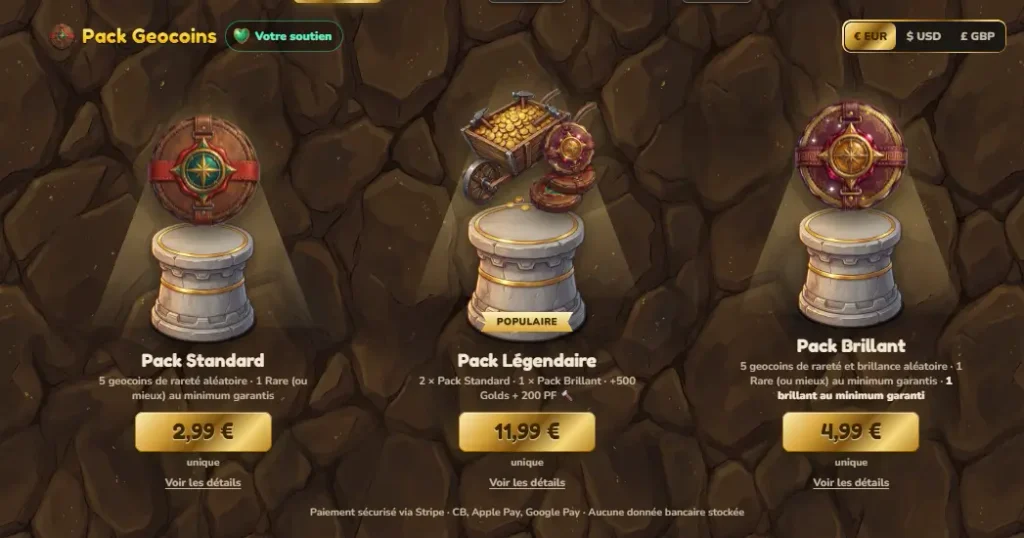
The shop opened on 28 August at 8:30 p.m., the same evening as the Reviewer expansion. It was designed primarily as crowdfunding, with openly displayed milestones.
And then… the first purchase came at 8:41 p.m. At 9:21 p.m., 51 minutes after opening, the first milestone was reached. By midnight, the fund stood at nearly four times the target. And on 1 October at 6:14 a.m., almost exactly a month after opening, the players had funded the server for an entire year. Beyond anything I’d hoped for. Incredible.
The money paid for doubling the server’s capacity so it could cope comfortably on busy evenings, and for adding Cloudflare anti-DDoS protection. It’s invisible work, with no new button or geocoin, but it’s what makes the game respond when you press “Join”. Contributions cover the site’s costs; the time I spend remains a labour of love.
To balance free players and contributors, I set rules from day one:
– Everything sold can also be earned by playing: in rounds, at the forge or at the market.
– You reach the top of the rankings through achievements, not with a credit card.
– No rigged lottery: while your collection is below 40%, a pack contains only geocoins you’re missing; up to 90%, at least one new geocoin is guaranteed.
Negative feedback? None. Only overwhelmingly positive reactions and a flood of encouragement. The geocaching community came through, far beyond anything I’d imagined. A free, ad-free game that will stay that way, with its server paid for a year by its own players: that’s the best recognition I could ask for.
How do you see the future of geocoins.io? What features would you still like to add, which new audiences would you like to reach, and how can players help keep the project going?
There’s a lot on the agenda! Christmas is approaching, with a few surprises in Santa’s sack. Then, on 2 January 2027, the Lackey expansion joins the game, bringing a new batch of caches to discover. Beyond that, ten events are already being prepared to keep things lively throughout the year.
As for ideas, the letter to Santa is a long one:
– An app on Google Play and the App Store. The Android version is well advanced. For the iPhone, I’ll have to get to grips with Apple and its developer licence.
– Rankings by association, an idea suggested by Caro93220.
– Duels, where you challenge a player of your choice over several rounds, with or without a stake.
– Private games with friends.
– New rarity levels—Kos is already dreaming of “super-legendaries”.
– Even more achievements.
– And one day, who knows, that much-discussed physical geocoin.
New audiences I’d like to reach? Geocachers outside France: the game already speaks four languages. And beginners, thanks to the new introduction that reveals the game step by step. With the app stores, I also hope to reach people looking for their next game on their phone who never visit a website. There are a thousand ways into geocaching; geocoins.io can be one of them.
Helping the project is simple: just play, and come and chat on Discord. Tell people about the game, including at events—the referral system rewards those who bring friends along. Report bugs and suggest ideas: half the game has come from that. And if you feel like it, give the funding pot a little boost. But only if you want to.
The memories and geocoins that matter
Among all the geocoins and caches in the game, are any particularly meaningful to you? If you could keep only one geocoin in geocoins.io, which would you choose, and why?
I’m going to cheat a little, because I can’t choose between members of my family. Geocaching-a-di-di and Poup & Youb: they’re my little family. If you play in Training mode, you’ve probably already met them without realising it, because three of the bots are called Adidi, Yubi and Poupy. Those are the nicknames of my child and my two cats.
And if I could keep only one memory of the game, it would be that evening in August when twelve players were still answering questions with nothing left to win, because they’d all passed their daily limit. I thought that managing to have fun together with nothing to gain was a pretty wonderful victory.
See you in the game, and happy hunting!
A huge thank you to Qgx for taking the time for this interview and giving us a look behind the scenes of Geocoins.io.
Now it’s your turn to discover the game at Geocoins.io! And if you already play, tell us about your experience in the comments.